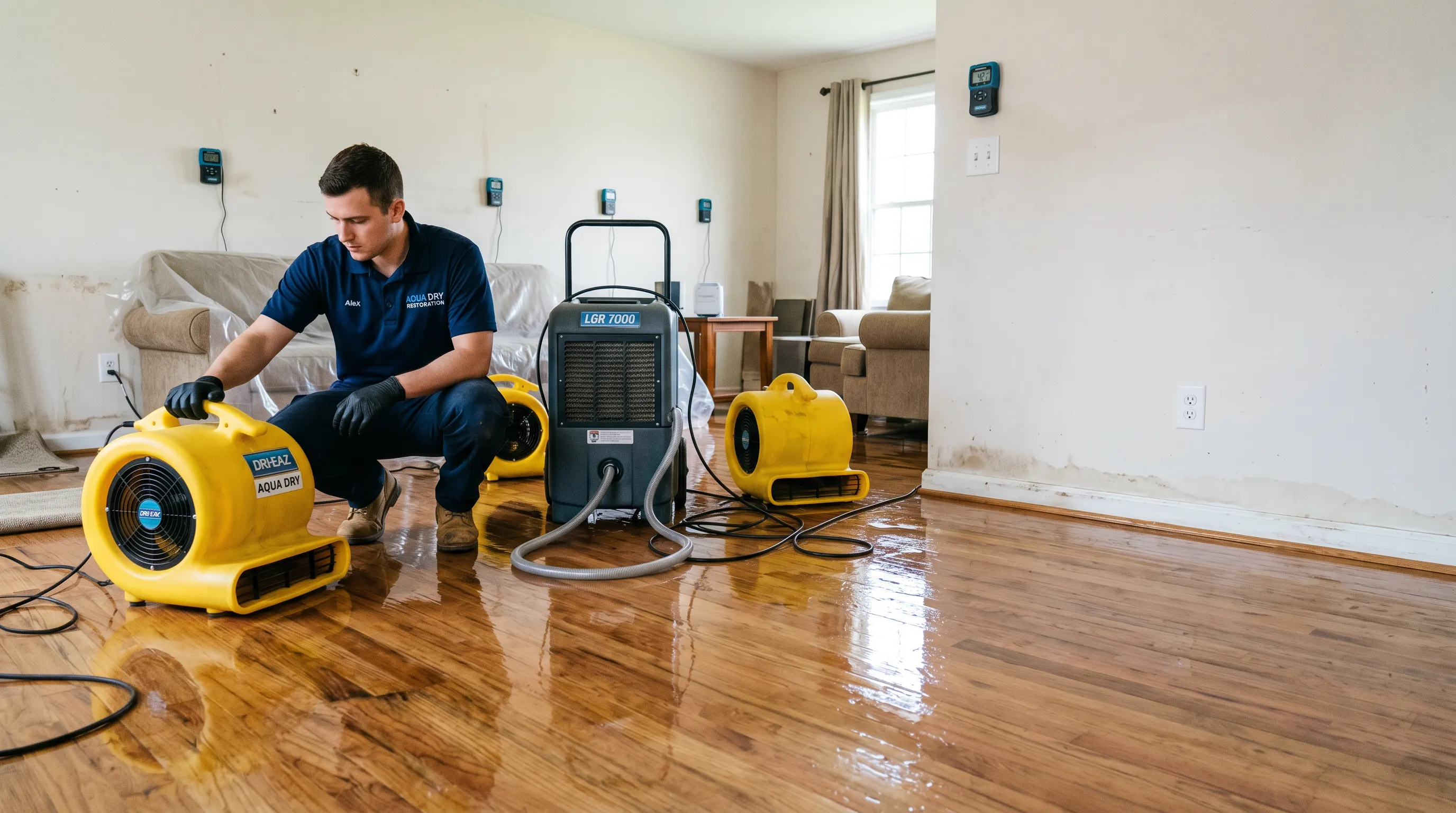
Water Damage Restoration professionals serving Charlotte, NC
Key Takeaways
•Charlotte has 20 listed water damage restoration professionals with an exceptional average rating of 4.9 out of 5 stars, giving homeowners strong options across all neighborhoods from Ballantyne to NoDa.
•Five companies in Charlotte have achieved a perfect 5.0-star rating, led by 247 Aquadry with 365 reviews — the highest review volume among top-rated providers, signaling consistent performance across a large sample size.
•Typical water damage restoration costs in Charlotte range from $1,200 to $5,600, with actual costs driven by the source of water, affected square footage, and whether secondary damage like mold has developed in the city's humid subtropical climate.
•Charlotte's position in a humid subtropical climate zone means water damage left unaddressed for even 24–48 hours has an elevated risk of mold colonization — making sub-60-minute emergency response a non-negotiable standard, not a premium feature.
•95% of listed Charlotte restoration businesses offer direct phone contact, meaning you should be speaking with a live person immediately during a water emergency — any provider routing you only to voicemail or a web form should be disqualified.
Water Damage Restoration in Charlotte: What You Need to Know
Charlotte is a city of rapid growth and dense residential development, with over 880,000 residents spread across neighborhoods that range from century-old bungalows in Plaza Midwood to sprawling new construction in Steele Creek and Tega Cay. That diversity of housing stock matters enormously when water damage strikes. Older homes in areas like Dilworth and Elizabeth often have cast iron or galvanized plumbing that corrodes from the inside, creating slow hidden leaks behind walls before catastrophic failure. Newer construction, particularly the wave of townhomes and condominium developments built during Charlotte's banking-era boom, brings its own vulnerabilities: shared wall cavities, complex HVAC condensate systems, and stacked plumbing chases where a second-floor leak becomes a first-floor ceiling collapse in under an hour. Understanding your home's construction era and plumbing type is the first step to assessing how serious any water intrusion event actually is.
Charlotte's humid subtropical climate is not a minor footnote — it is the defining factor that separates how water damage behaves here versus in drier markets. With average relative humidity regularly exceeding 70% during summer months, moisture trapped inside wall cavities, under flooring, or in crawl spaces does not dry passively. It lingers, and within 24 to 72 hours of a water intrusion event, mold spore colonization can begin on organic building materials like drywall, subfloor sheathing, and wood framing. This is why the 60-minute or less response time standard exists — not as a marketing promise, but as a practical boundary between a contained water damage job and a full mold remediation project that can double or triple the total restoration cost. Of the 20 listed restoration professionals in Charlotte, the top-rated providers consistently cite rapid deployment as their first operational priority, and the review data backs that up: 247 Aquadry's 365 reviews and 5.0-star rating represent the kind of sustained, high-volume performance that only comes from teams that reliably show up fast and complete the job correctly.
Charlotte's status as the second-largest banking center in the United States has also shaped its real estate market in ways that affect water damage restoration. The city's high concentration of corporate relocations means a significant portion of homeowners are new to the Carolinas and unfamiliar with regional weather patterns — specifically, the threat posed by Atlantic hurricane remnants, severe summer thunderstorms, and the occasional winter ice storm that can overwhelm gutters, freeze pipes in poorly insulated crawl spaces, and saturate foundation walls. Local restoration professionals who operate specifically in Charlotte understand these regional triggers. A national franchise dispatching a team from Greensboro or Columbia may lack the hyper-local knowledge of which Charlotte neighborhoods sit in low-lying areas prone to basement seepage, or which construction eras used building practices now known to trap moisture.
Charlotte Local Tip: Homes in the University City, Steele Creek, and South End corridors built between 2005 and 2015 frequently used Chinese drywall or synthetic stucco (EIFS) cladding systems that are especially susceptible to moisture intrusion and difficult to dry with standard equipment. If your home was built during that window and you experience water damage, specifically ask your restoration provider whether they have experience with EIFS systems or synthetic stucco before signing any work authorization.
How Much Does Water Damage Restoration Cost in Charlotte?
In Charlotte, water damage restoration costs typically range from $1,200 to $5,600 depending on the scope and category of loss. That range, however, can expand significantly when secondary damage — particularly mold remediation in Charlotte's humid climate — is required. The primary cost drivers are the water category (clean water from a burst pipe versus gray water from a dishwasher overflow versus black water from sewage backup), the total affected square footage, the number of building assemblies impacted (flooring, drywall, insulation, structural framing), and how quickly mitigation began after the event. Every hour of delay in a Charlotte summer adds measurable humidity load to the affected space, which translates directly to additional drying equipment, extended equipment rental days, and higher labor hours on your final invoice.
Charlotte homeowners should also understand how insurance intersects with restoration costs here. Mecklenburg County and surrounding Cabarrus, Union, and Gaston counties have seen increased homeowner insurance scrutiny on water damage claims, particularly for gradual leak damage versus sudden and accidental events. Most standard homeowner policies in North Carolina cover sudden water damage but exclude slow leaks or seepage — meaning the cause of loss can determine whether you pay $500 out of pocket or $5,600. Top-rated Charlotte restoration companies typically offer direct insurance billing and can assist with the documentation process, but you should independently understand your policy's water damage provisions before an emergency occurs, not during one.
Service
Low Estimate
High Estimate
Notes
Clean Water (Category 1) — Burst pipe, appliance supply line
Low$1,200
High$2,500
Most common in Charlotte during winter ice storms affecting crawl spaces; fastest resolution if addressed within 24 hours
Frequent cause in Charlotte's newer townhome and condo developments; requires antimicrobial treatment of affected materials
Black Water (Category 3) — Sewage backup, floodwater, storm surge
Low$2,500
High$5,600
Elevated risk in Charlotte neighborhoods near Sugar Creek, Little Sugar Creek, and Four Mile Creek corridors during heavy storm events; full PPE and containment protocols required
Mold Remediation (Secondary Damage)
Low$1,500
High$4,000
Becomes necessary when water damage goes unaddressed for 48+ hours in Charlotte's high-humidity environment; costs are additive to primary restoration scope
Charlotte Money-Saving Tip: Before authorizing any work, ask your restoration company whether they offer direct insurance billing and assignment of benefits processing. Most top-rated Charlotte providers handle this as standard practice, which eliminates out-of-pocket advance payments while the claim is processed. Also, request an itemized written estimate that separates emergency mitigation (water extraction, drying equipment placement) from reconstruction costs — some insurers in North Carolina reimburse these phases separately, and a bundled estimate can delay your claim approval.
How to Choose the Right Water Damage Restoration in Charlotte
5 Questions to Ask Before Hiring a Charlotte Water Damage Restoration Company
Are your technicians IICRC-certified, and can you provide certification documentation before work begins? The right answer is yes, immediately. IICRC (Institute of Inspection, Cleaning and Restoration Certification) is the industry's governing credentialing body. In Charlotte's competitive market, any reputable provider will have certified Water Damage Restoration Technicians (WRT) on staff. If a company hesitates, cannot name the specific certification held, or says certifications are 'in progress,' treat that as a disqualifying response.
What is your guaranteed response time to my address in Charlotte, and do you have crews currently positioned in the metro area? The right answer is 60 minutes or less with local crews — not a dispatch center routing technicians from a regional hub. Charlotte's sprawl from Huntersville to Pineville means travel times matter. A company headquartered in Gastonia or Monroe may quote Charlotte service but arrive 90 minutes later than a locally based team.
Will you work directly with my homeowner's insurance carrier, handle the documentation and claims process, and provide moisture readings and drying logs as part of your standard service? The right answer is yes to all three. Moisture logs and psychrometric data are required by most North Carolina insurers to validate drying completion. A company that cannot produce these documents puts your claim reimbursement at risk.
Do you own your drying and extraction equipment, or do you subcontract equipment from a rental house? The right answer is owned equipment, maintained to IICRC S500 standard. Rental equipment in Charlotte's high-demand storm season is frequently unavailable or poorly maintained. Companies owning their fleet can guarantee equipment deployment and performance.
Can you provide references or reviews from jobs completed in my specific Charlotte neighborhood or zip code within the last 12 months? The right answer is yes, with specificity. A company with 300+ reviews and a 5.0 rating in Charlotte has a demonstrated track record across the metro. General references from other cities or counties do not speak to knowledge of local building codes, soil conditions, or moisture dynamics specific to Charlotte's Piedmont geography.
Red Flags When Hiring Water Damage Restoration in Charlotte
Red Flags to Watch For When Hiring a Charlotte Water Damage Restoration Company:
Storm Chasers and Out-of-State Contractors: After major weather events — particularly the tropical remnants and severe thunderstorms that move through Charlotte from June through November — out-of-state contractors flood the market. They frequently lack North Carolina contractor licensing, carry inadequate insurance, and disappear after collecting partial payment. Always confirm the company has a physical Charlotte-area address and is licensed to operate in North Carolina before authorizing any work.
Pressure to Sign Immediately Without a Written Estimate: Any contractor who insists you sign an open-ended authorization before providing an itemized written estimate is creating conditions for invoice abuse. Legitimate Charlotte restoration companies provide scope documentation before work beyond emergency water extraction begins.
No Proof of Liability Insurance or Worker's Compensation: Water damage work in occupied Charlotte homes requires both general liability insurance and workers' compensation coverage. Ask for certificates of insurance naming you as an additional insured. Uninsured contractors performing work in your home transfer liability to you if a worker is injured on your property.
Promising Mold Results Before Testing: Any contractor who guarantees mold-free results before conducting post-remediation clearance testing is making a claim they cannot scientifically support. Legitimate Charlotte providers follow IICRC S520 protocol, which requires independent post-remediation listing, not a verbal assurance.
Cash-Only Pricing or Unusually Low Bids: Bids that come in dramatically below Charlotte's typical $1,200–$5,600 range for standard restoration are frequently underscoped — meaning the contractor is cutting line items that will either be added back as change orders or simply left undone, leaving hidden moisture in your walls. Equipment rental costs, labor rates, and antimicrobial treatments have fixed market prices in Charlotte; there is no legitimate basis for a bid that falls 40–50% below market.
Top-Rated Water Damage Restoration Companies in Charlotte
Among the 20 listed water damage restoration professionals in Charlotte, five companies have achieved a perfect 5.0-star rating. What distinguishes these providers is not simply that they have high ratings — it is that they have maintained those ratings across meaningful review volumes, which is a significantly harder standard to meet and a more reliable indicator of consistent operational quality.
247 Aquadry leads the Charlotte market with a 5.0-star rating across 365 reviews — by far the largest review sample of any top-rated provider in the city. That volume matters. A 5.0 rating built on 365 reviews represents sustained performance across hundreds of unique jobs, seasonal conditions, and claim complexities. It is the benchmark against which other Charlotte providers are measured. For homeowners who prioritize proven track record above all other factors, 247 Aquadry's review profile is the most defensible choice in the market.
Pure Air Charlotte brings a 5.0-star rating with 164 reviews, making it the second-most reviewed top-rated company in Charlotte. The company name signals a specialization in indoor air quality alongside water damage restoration — a combination that is particularly relevant in Charlotte's humid subtropical climate, where water damage events frequently escalate to air quality concerns through mold colonization and off-gassing from wet building materials. For homeowners dealing with water damage in homes with occupants who have respiratory sensitivities, Pure Air Charlotte's dual focus on restoration and air quality is a meaningful differentiator.
Sunshine Restoration Group holds a 5.0-star rating with 157 reviews, placing it among Charlotte's most consistently rated providers. SERVPRO of Southwest Charlotte carries a 5.0 rating with 71 reviews — notable because SERVPRO as a national franchise brings standardized IICRC training protocols and insurance billing infrastructure, while the Southwest Charlotte franchise's local reviews indicate that the regional operator is executing to that standard rather than coasting on brand recognition. ADU Water Fire Mold Storm rounds out the five-star tier with 58 reviews, and the company's explicit multi-hazard positioning — water, fire, mold, and storm — indicates broad capabilities for Charlotte homeowners dealing with complex, multi-category loss events following severe weather.
Company
Rating
Reviews
Best For
247 Aquadry
5.0★
365
Homeowners who prioritize proven track record; highest review volume in Charlotte market signals consistent performance across all job types and seasons
Pure Air - Charlotte
5.0★
164
Homes with occupants who have respiratory sensitivities; dual specialization in water damage restoration and indoor air quality is critical in Charlotte's high-humidity environment
Sunshine Restoration Group
5.0★
157
Full-service residential restoration with a strong local Charlotte reputation; consistent 5-star performance across a substantial review base
SERVPRO of Southwest Charlotte
5.0★
71
Homeowners navigating insurance claims who need standardized IICRC documentation, national brand accountability, and direct insurer billing infrastructure
ADU Water Fire Mold Storm
5.0★
58
Complex multi-hazard losses — particularly post-storm events combining water intrusion, mold risk, and structural damage — requiring a provider with cross-category expertise
Seasonal Guide to Water Damage Risks in Charlotte
Charlotte's water damage risk profile follows a distinct seasonal pattern shaped by its humid subtropical climate and geographic position in the Carolina Piedmont. Understanding that pattern lets homeowners take preventive action before emergencies occur — and helps explain why certain times of year create backlogs for even the best-rated restoration companies in the city.
Summer (June through September) represents Charlotte's highest-risk period for water damage events. The Atlantic hurricane season runs June through November, and while Charlotte sits approximately 200 miles inland from the coast, it regularly receives tropical storm systems that produce 4 to 8 inches of rainfall in 24 hours or less — well beyond the capacity of most residential drainage systems. The remnants of major hurricanes have directly impacted Charlotte multiple times in recent decades, causing widespread basement flooding, roof failures, and stormwater intrusion through foundation walls in neighborhoods built on the area's clay-heavy Piedmont soils. Clay soils absorb water slowly and hold it at high saturation levels for extended periods, meaning foundation hydrostatic pressure continues building for days after a storm event ends. Homeowners with finished basements or below-grade living spaces in Charlotte neighborhoods like Ballantyne, Southpark, and Myers Park should treat any significant rain event as a potential water intrusion risk requiring inspection. During peak storm season, Charlotte's top-rated restoration companies can experience demand surges that extend response times beyond the normal 60-minute standard — which makes pre-establishing a relationship with a preferred provider, rather than searching during an emergency, a genuinely practical preparation strategy.
Fall (October through November) brings a secondary risk window as hurricane season winds down but temperatures begin dropping and heavy leaf accumulation clogs gutters and downspouts. Overflowing gutters during fall rain events are one of the most common and preventable causes of water intrusion behind Charlotte exterior walls and into crawl spaces. Annual gutter cleaning before November in Charlotte is not cosmetic maintenance — it is a legitimate water damage prevention measure. The transition to cooler temperatures also accelerates moisture condensation in attic spaces and crawl spaces that were holding elevated humidity levels from summer, making fall a common season for discovery of hidden mold colonies that developed during summer moisture events.
Winter (December through February) introduces pipe freeze risk that many Charlotte homeowners underestimate. Charlotte's winters are generally mild, but the city experiences multiple hard freeze events each season — typically overnight temperature drops to the mid-20s Fahrenheit — that can freeze pipes in exterior walls, uninsulated crawl spaces, and garage walls. Charlotte's significant inventory of older homes with cast iron supply lines and limited crawl space insulation is particularly vulnerable. The January 2022 winter storm that impacted Charlotte produced a surge of burst pipe claims that overwhelmed local restoration capacity for more than two weeks. Homeowners should insulate crawl space plumbing, know the location of their main water shutoff valve, and keep a preferred restoration company's number accessible before winter freeze events are forecast.
Spring (March through May) in Charlotte brings sustained rainfall patterns and the thawing of any frozen ground moisture, increasing stormwater runoff volume across the Mecklenburg County watershed. Homes near Charlotte's urban creek network — including Little Sugar Creek, McMullen Creek, and Briar Creek — face elevated backwater and surface flooding risk during spring storm sequences. Spring is also the optimal season for proactive crawl space inspections, moisture barrier assessments, and sump pump testing before summer storm season begins. The highest-rated Charlotte restoration companies typically offer inspection services, and scheduling a spring inspection is significantly less expensive than emergency mitigation following a summer flooding event.
Frequently Asked Questions About Water Damage Restoration in Charlotte
How quickly should a water damage restoration company arrive at my Charlotte home after I call?
The industry standard for emergency water damage response is 60 minutes or less, and in a metro area the size of Charlotte — with 20 listed restoration providers serving 880,000 residents — there is no legitimate reason to accept a longer response time. Charlotte's humid subtropical climate means that every hour of delay allows ambient humidity to work against the drying process. The top-rated companies in Charlotte, including 247 Aquadry and Pure Air Charlotte, maintain local crews and equipment to meet or beat the 60-minute threshold across the metro area. If a company quotes you a 2–4 hour arrival window for an active water loss situation, continue calling until you find a provider who can respond within an hour.
Will my homeowner's insurance cover water damage restoration costs in Charlotte, and what does coverage typically exclude?
Standard North Carolina homeowner's insurance policies generally cover sudden and accidental water damage — a burst pipe, an appliance failure, or storm-driven water intrusion through a damaged roof or window — but typically exclude gradual damage from slow leaks, seepage through foundation walls, and flooding from external water sources (which requires separate NFIP or private flood insurance). In Charlotte's heavy storm environment, the distinction between 'storm-driven intrusion' and 'ground flooding' can significantly affect your claim outcome. Document the cause of loss with photographs immediately, do not discard damaged materials before an adjuster visits, and work with a restoration company that provides written moisture logs and scope documentation — this paperwork is what gets insurance claims approved in North Carolina, not verbal descriptions. SERVPRO of Southwest Charlotte and other top-rated Charlotte providers are experienced in direct insurance billing and documentation requirements.
Find Water Damage Restoration Professionals in Charlotte
Browse top-rated contractors, compare reviews, and get free quotes.
How long does water damage restoration typically take in Charlotte, and when can I return to my home?
The timeline depends on the scope and category of water damage. For a Category 1 (clean water) event affecting a contained area — say, a laundry room and adjacent hallway — emergency water extraction takes 2–6 hours, followed by a structural drying phase of typically 3–5 days using commercial dehumidifiers and air movers. Charlotte's ambient humidity during summer months extends drying times compared to drier climates, because equipment must work harder to drive moisture from building materials against a high-humidity baseline. Category 2 or Category 3 events, or any event affecting multiple rooms or structural assemblies, extend the timeline to 5–10 days for drying alone, followed by a reconstruction phase. Most families can remain in their home during Category 1 mitigation if the affected area is isolated. Category 3 events involving sewage or floodwater require temporary relocation during remediation as a health and safety measure.
What does IICRC certification mean, and why does it matter specifically for Charlotte restoration companies?
The IICRC (Institute of Inspection, Cleaning and Restoration Certification) is the internationally recognized standards body for the restoration industry. IICRC certification — specifically the Water Damage Restoration Technician (WRT) credential — means a technician has been trained in psychrometric science, moisture measurement, drying system design, and the category and classification protocols that determine how a job is scoped and priced. In Charlotte specifically, IICRC certification matters for two reasons: first, North Carolina's high-humidity climate requires technicians who understand how ambient conditions affect drying calculations and equipment selection — an uncertified technician may pull equipment too early based on a visual assessment rather than actual moisture readings. Second, most Charlotte-area insurance carriers require IICRC-compliant drying documentation — moisture readings, equipment placement logs, daily psychrometric data — to validate completed mitigation before approving reconstruction reimbursement. Hiring an uncertified crew in Charlotte does not just risk a poor drying outcome; it can jeopardize your insurance claim.
What are the signs that water damage in my Charlotte home has progressed to mold, and what should I do?
In Charlotte's humid subtropical climate, mold colonization can begin as soon as 24–72 hours after a water intrusion event on organic building materials like drywall, wood framing, and carpet padding. Early indicators include a musty, earthy odor that persists after visible water has dried, discoloration on walls or ceilings that appears fuzzy or has irregular borders rather than uniform water staining, and unexplained respiratory irritation or allergy symptoms in occupants. If you discover these signs — or if a water damage event went unaddressed for more than 48 hours — do not attempt DIY mold remediation. North Carolina Environmental Health guidelines and IICRC S520 protocol require containment, negative air pressure, HEPA filtration, and post-remediation clearance testing to confirm successful removal. Among Charlotte's top-rated providers, Pure Air Charlotte's explicit air quality specialization and ADU Water Fire Mold Storm's multi-hazard positioning are both appropriate choices for suspected mold situations. Addressing confirmed mold typically adds $1,500–$4,000 to the total project cost, which reinforces the importance of rapid initial response to any water intrusion event.
Best Water Damage Restoration in Charlotte, NC — Complete 2026 Guide | Water Damage Restoration